What Makes Us Stronger: A Review of Christine Stroud’s The Buried Return by Mindy Kronenberg

cover credit: Finishing Line Press

The Buried Return by Christine Stroud
Finishing Line Press (2014)

Reviewed by Mindy Kronenberg

Christine Stroud’s debut chapbook is a collection of poems that are each a cautionary tale. These disturbing but determined narratives face the harrowing realities of love (both carnal and familial), loss, and random rites of passage emerging from the domestic and feral realms. The adolescent bravado that begins this journey evolves into adult indignation and self-recognition with every vignette, and raw emotions are crafted with literary precision.

The first poem, “I Threw Your Shoes into the River,” is a provocative start. The poet claims not to regret the gesture (for an unnamed victim). Yet, in this passage, there remains a searing image of summer shoes thrown defiantly and disappearing from view:

… But I

stood at the end of the pier
and watched your Day-Glo orange
flip flops float down the White Oak
until they were nothing
but a burnt smear on the water.

Many of the poems in The Buried Return are encounters meant to haunt the reader, pull us out of a comfort zone that so many poets struggle to preserve. The way Stroud summons empathy and trepidation from visceral (and sometimes alarming) details recalls Theodore Roethke’s and Sharon Olds’s rending of personal violence into eloquent verse—the language sublimely releasing events that make us wince. The brutality of ignorance and bigotry and the complicated injustice of victimization is rendered in “Farmville High,” where a lesbian student is physically attacked by two boys after school. The tension begins before the violence, as her attackers position themselves (“One at each end of the hall. / Even before they yelled / dyke, you understood.”). The carnage that follows leaves us speechless:


They shattered you
under long fluorescent
bulbs running parallel
to the cobalt blue lockers.
Those lights always
too clear, too white.

In silence, the doctors
rearranged you, wrenching bones,
wiring your mouth shut.

Lessons of loss and mortality are poignantly demonstrated in two poems, “Knowing” and “On the Way Home from a Bar in Portland,” which take place respectively in childhood and adulthood. Focusing on a hunt for a lost cat and an encounter of another, horribly wounded, each deals with the uncomfortable urges of hope and bravery, survival and merciful death. In the first poem, configured as a prose narrative, the discovery disappoints: “I find him. Curled up like a roly poly, his mouth hanging open, blood on his / teeth. His tiger-striped fur looks soft and I bend down to stroke him. Dad / grabs my hand, No he could have diseases. …” In the second poem, a more formally constructed narrative that is built on self-doubt and ending suffering, the poet follows a “tar trail of blood” to a hedge where the animal appears:

… He was a pair of torn black pantyhose,
leaking thick pink mucus. I should’ve gone home. …

I envisioned snapping his neck bone.
Instead I scratched him between the ears, stilled
by his sticky, short breath. I got up, walked home.

There are several poems on family with their own brand of spirited, celebratory dynamic, as when a walk in a graveyard becomes a bonding session for mother and daughter (“Graves We’ve Shared”), a father-daughter fishing expedition that’s a lesson on “the patience of stillness” (“Fishers”), and a hammock nap recreating the loving tension between the practical grandmother and rebellious sprite (“Grandmother”). A complicated chasm between revelry and sobriety exists in poems on friends and lovers (particularly in four “Relapse Suites”), and even the most raucous scenes contain imagery and detail with a peculiar beauty—“as bullets fell into the snow / like awful inverted stars…” (“Relapse Suite, Ashville”) and “It was so cold in your room / the door handle sparkled / with frost.” (“Relapse Suite, Pittsburgh”).

The Buried Return is by turns tragic and tender, wild and disciplined. Stroud unearths what we fear and desire, and reminds us how poetry can haunt both our conscience and consciousness, chronicling and shaping the lives we choose for ourselves.

Structures on Fire: A Review of Kristina Marie Darling’s Scorched Altar: Selected Poems & Stories by Julie Babcock

cover credit: BlazeVOX Press

Scorched Altar: Selected Poems & Stories by Kristina Marie Darling
BlazeVOX Press (2015)

Reviewed by Julie Babcock

Kristina Marie Darling is an exciting voice in contemporary poetry. The seven-year span of this collection represents work from twelve different published books. It offers readers a chance to see a highly productive mind work through recurring concerns about genre and representation in an almost limitless ways. The core of Darling’s work centers on questions about whose stories last, why, and how that can be changed. She explores these questions through various forms that draw attention to the ways narratives both layer and erase. “What does a white dress not resemble?” Darling asks as her readers slip into a house and notice a man staring out a window, “Tell me what you see in him / A locked room, but what else—?”

Darling draws upon an evocative backdrop of Victorian images and associations to explore academic and political questions. Her writing, especially in the earlier selections, is filled with phonographs, exotic birds, silk gloves, and fancy dresses. Behind all this nostalgic glamour, though, is a terrifying sense of menace. As the title of one of her books asserts, “The body is a little gilded cage” and traps, poisons, and fires abound.

In some ways, Darling’s writing shares affinities with Mark Z. Danielewski’s, who plays with form and content but manages to create a highly charged tangible experience. House of Leaves is simultaneously a horror story, a love story, and a satire of academic criticism. Darling’s writing works on these multiple layers through an exciting feminist lens. Selections from Melancholia (An Essay) includes footnotes, a glossary, prose poems, and noctuaries: “She wanted to understand the innermost workings of this strange machine. Their courtship was a system of pulleys, levers, and strings.”

Darling’s writing simultaneously evokes the passage of time and refuses it. The women in her poems face the possibilities and devastations of love and power in unsettling ways that happen both two hundred years ago and now. Darling interrogates the structure of courtship and marriage—both its desire and dread—through women whose work, talents, and love have been dismissed or ignored by men. She demonstrates how much these dismissals have missed. In the earlier selections, courtship structures are presented as seductive acts of lyrical transcendence, such as in the prose poem “City Walk.” She describes:

When our taxi arrives, I brush the soot from my long white sleeves. Your gold
cigarette case flips open & I begin to notice the stains on your French silk cuffs.

In the later selections, attempts at lyrical transcendence are much more undercut inside each poem. For instance in “Landscape,” Darling writes:

You kept mentioning the other women, the way they would lie on their backs in the
grassy field. All around them were breadknives. The place settings for a picnic.

The fragmented sentences in this poem, combined with the deadpan humor of the breadknives and the more directly accusatory tone taken by the speaker, allow the reader to be in both a timeless and time-bound setting of this park. The poem continues:

But even before that we were quarreling. You told me, tilting your pretty head, how my pastoral elegy failed to move you.

Here, the reference to the pastoral elegy in a poem written in a 21st-century tone connects the ways the “you” trivializes both the death of a historic past and the death of their current relationship. Although the lines demonstrate the “you’s” dismissiveness, they also convey a delightful power shift. The speaker condescends the “you” by describing him in midst-quarrel as “tilting your pretty head.” From there, the action and imagination of the speaker builds in power. These power shifts occur frequently in Darling’s writing, and she seduces readers with sublime beauty, creeping terror, and possibilities to think and do otherwise. For instance, in her most recently excerpted book, The Arctic Circle, the woman in the prose poems may be freezing to death in her husband’s house, but unlike the husband, who can’t seem to make a distinction between repetition and difference, the speaker “understands why the boxes are empty, knows fact from fiction.” In “Your Only Wife” the same woman is:

… trying to warm the
endless rooms. You sense that what you had imagined is impossible: the faint
music, the chandeliers, and the bride’s mind gone pale with waiting.

These lines show the impossibility of a stereotypical romantic gender construction. The pale mind cannot be sustained, and this failure highlights the necessity to imagine in more constructive ways. To experience seven years of Darling’s prolific writing career is to witness the inexhaustibility of a compelling idea and a necessary set of interrogations. The poems in Scorched Altar are feeding a magnificent fire.

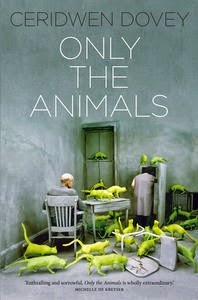
Humans and Animals: Connected at Heart: A Review of Ceridwen Dovey’s Only the Animals by Tansy Bradshaw

cover credit: Penguin Australia

Only the Animals by Ceridwen Dovey
Penguin Australia (2014)

Reviewed by Tansy Bradshaw

Winner of 2014’s Readings Bookstore New Australian Writing Award, Ceridwen Dovey’s second novel is best described as a variety of short stories and letters. Less than 250 pages, this book’s rich stories peak to everyone.

In Only the Animals, ten animals are caught in human conflict that ranges from a camel who was in the presence of Australian author Henry Lawson to a letter written to Sylvia Plath by a dolphin. With each story, readers glimpse into the hearts of the animals that stoically stood by their owners or, like their owners, dreamed of a better life. Giving a unique insight into the animal psyche, these stories reveal the raw suffering and joy that the real heroes experienced like losing a loved one or the fear of uncertainty.

The book also pays homage to writers who chose to write about animals. As well as Sylvia Plath and Henry Lawson, Dovey includes Kafka, Ted Hughes, Leo Tolstoy, and Jack Kerouac. In a story with a camel who is the animal accompanying Henry Lawson during a trek in Queensland, she writes with Lawson’s style as she creates images of Australia’s outback by drawing on the Australian bush and referencing its natives. This is evident in the passage, “The goanna was moving through the dry leaves, making them scrape against one another like cartilage.”

Dovey has a unique ability to make well-rounded and lifelike characters. For example, “Pigeons, a Pony, the Tomcat and I,” set on the Western Front, is a story about a cat reminiscing about her owner’s life in Paris. There, the actress was known for her theatrical antics, and the cat remarks, “… how entranced Collette would be by this little scene…” like walking her on a lead around town.

A more touching story in this collection is “Plautus: A Memoir Of My Years on Earth and Last Days in Space,” in which a soul of a tortoise writes about Virginia Woolf’s life by replicating her essay A Room of One’s Own with one segment called “A Terrarium of One’s Own.” The tortoise remembers when Virginia discovered him in a box. The tortoise says that “she had done what she usually did when she encountered a new phenomenon … and went to literature.” This story provides an alternative look at a writer, who was living through social change at the time of writing her piece. A Room of One’s Own was her stating that she did not wish to be just known as a house wife, wanting a place where she could write and devote herself to her work. For the time where men hold the balance of power this was a stand for women’s rights.

Only the Animals is a beautiful piece of literature that makes readers ponder the lives that these animals and authors may and lived. Dovey seems to ask whether readers can understand an author better by looking at the symbolic use of animals within their work. For example, Kafka symbolised disability and the feeling of helplessness through the representation of being a cockroach that has fallen on his back and is unable to be righted. She also postulates whether animals can return feelings we wished we received from other humans: unconditional love? Only the Animals seeks out the empathy in everyone, whether it be for animals, humans, or for both. It all but hands a typewriter to a beloved pet.

Rust Never Sleeps: A Review of Rochelle Hurt’s The Rusted City by Angele Ellis

cover credit: White Pine Press

The Rusted City: a novel in poems by Rochelle Hurt
White Pine Press (2014)

Reviewed by Angele Ellis

“…Using elements of surrealism and magic seemed like the best way for me to write a place like Youngstown into something new. A mythical approach allowed for this more than a documentary style would have, which is why I chose to call my city simply ‘The Rusted City’ and not Youngstown.” ~ Rochelle Hurt in an interview with Belt Magazine, December 2014

The reader enters Rochelle Hurt’s lost kingdom through an empty chair. Her cover illustration, Sharon Pazner’s “Throne,” is a doll-sized, kitchen-chair construction of concrete and bent, tarnished nails that might guard a parking space in any American Rust Belt city. Delicate and tough, homely and haunting, it is a near perfect metaphor for the world Hurt recreates from rough materials and memory.

Hurt’s impressive debut is a full-length collection of prose poems mixed with free verse (the eighteenth volume in the Marie Alexander Poetry Series). It reads like an extended fairy tale, a modern version of an old-fashioned story in which rust/blood, fear, and pain leave trails on the road to rebirth. Her recurring characters—The Quiet Mother, The Favorite Father, The Oldest Sister, and The Smallest Sister—are archetypes into which the poet breathes harsh individual life.

In “The Smallest Sister Decides to Make Herself Red,” this child character “often” takes into herself relics of the rusted city. “… She strings corroded washers into a necklace. She dresses her lips in the sanguine water and sucks the stain from the pipes behind the aluminum plant…” As in a fairy tale, these rituals age The Smallest Sister beyond even The Favorite Father’s reach, as demonstrated by the following punch line:

… When he touches her, she is as old as the city that closes around them like a fist.

The Favorite Father is a photographer as well as a mill worker. In “The Roller Coaster is Burning, the Favorite,” “father tells his daughters, buttoning their chin and ear flaps. ‘We’ve got to get pictures.’” But the family, walking in “a line of red caps… a lit fuse,” is too late for the burning but not the death. Hurt describes the grotesque scene:

… the roller coaster is folded in half, a writhing lattice… gangly as a giant insect… its corroded arms are crossed already—the death pose, the smallest sister knows.

In “The Favorite Father Chases a Tornado,” his daughters’ attention is not on “[t]he sky [that] troubles and fills with orange funnels” but on the way the father “ruined” the rust-coated river while “getting his shot.” Hurt writes in this striking sequence:

… A layer of rust floating like algae on the water begins to break up. As he wades, his legs part one red island, making another. Soon there are too many rust islands to count, and the river is a mottled red-brown.

The Rusted City often turns moments of creation into destruction. In “The Quiet Mother Smiles,” the house crumbles around the mother as she cleans her wedding ring in anticipation of the father’s return. The reader feels the chill of ill omen:

… The ring is heavy as a marble in the smallest sister’s hand, and heavier every minute… The quiet mother picks chips of rust from where the ring had hugged her finger and blows on it like something too hot, sending a storm of red to the floor.

The titles of poems in the second and fourth sections of this five-part collection begin “In the Century of…,” bringing the weight of history to bear on subjects as small as lunch pails, dusty hallways, and dirty water, and as large as records, research, and silences. In Belt Magazine, Hurt says:

“Using ‘In the Century of’ was my way of avoiding the constraints of literal time, which seem irrelevant to history in terms of how it’s told between family members and how it affects the lives of individuals. When history is remembered through our own experiences, it always gets warped and mythologized. There are so many centuries in this book that by the end, the city is thousands of years old. In this way it becomes larger than real life.”

“In the Century of Birthmarks” is a startling example of how Hurt positions the rusted city as an eternal city, as demonstrated by the poem’s opening stanza:

parents held their newborns up
to the sun and read the shadows
cast through them like runes.

And “In the Century of Lunch Pails,” the industrial city becomes a noisy, all-consuming monster: “… Everywhere the chew of pipes branching / through copper soil could be heard.” It leeches life from the lunch pail-carrying fathers even as it provides their livelihood, as in its eerily beautiful closing stanzas:

Everywhere the whisper ticks of fingers,
every hand a clock. And every evening,

the clinking, ever nearer the doorstep, of coins
inside all the hollowed-out fathers as they walked.

Hurt ends The Rusted City with two poems of death and rebirth. In “The City Opens” (like a corpse, or a Caesarian section) the smallest sister rebuilds from its amazing array of “expelling antiques.” “… Every night another wall, every week another room, every month another house—her new city birthed from the refuse.” And in “The Smallest Sister is Radiant,” the smallest sister imagines her death as “… a grenade of rust, fool’s gold… She can’t say why she / swallows the word, but when she does she knows it will burst in her / throat one day.” However, death cannot destroy the city that words have immortalized, as shown in the book’s last lines:

… but she knows that at the moment of death, she
will be brilliant. Her body will shine like a city inside.

In Pursuit of Shenanigans: A Review of Dan Nowak’s the hows and whys of my failures by Anthony Frame

Cover credit: Hyacinth Girl Press

the hows and whys of my failures, by Dan Nowak
Hyacinth Girl Press (2014)

Reviewed by Anthony Frame

The bio note for Dan Nowak’s third chapbook, the hows and whys of my failures, concludes, “Dan takes his time to pursue worthwhile shenanigans with the love of his life.” The pursuit of shenanigans, often in the name of love, turns out to be an apt description of these fourteen short, stream of consciousness poems that race from curiosity to conclusion at a manic pace. Throughout, Nowak’s abrupt line breaks and his complex interplay between ideas and language strip away the artifice of the modern world and leave the reader staring, at times uncomfortably, at how these naked poems wrestle with the world in which they live.

The collection opens simply, plainly, and absurdly: “you’re beautiful like a dolphin.” This, according to the opening poem’s title, is “one of many failed pick-up lines.” This immediately extends the possibilities of what Nowak might do and where he might go over the next fourteen pages. The poem then jumps from the speaker’s failure to find dolphins attractive to a brief meditation on imaginary “future and science fiction children.” By the end, when the speaker decides truth is obnoxious (“almost like a dolphin”), Nowak has fully prepared us for the voice, the tone, and the style of his chapbook. But, perhaps more importantly, he has prepared us for the pace of these poems.

They are frenetic, so much that they push the limits of comfort. Take, for example, “this is my rifle.” Over the course of fourteen lines, Nowak writes about love as a gun, his lack of scholarly knowledge, his inability to talk to a girl, ruminations on how the girl might kiss, how much he has had to drink, a brief meditation on attraction, questions about how the night was supposed to go, a post-party cleanup, and waking up alone. And all of these are strung together without punctuation. But Nowak deftly holds these thoughts together through the rifle metaphor, which transforms from being about love to being about attraction to, finally, being about the speaker’s penis. This transformation coincides with the speaker daydreaming about the girl. As his fantasies intensify to the point of disintegration, so too does the rifle metaphor until all that is left is the speaker “alone again with my hand down my pants and drinks i meant to buy still in my pocket.”

Each of these poems works in a similar way (see, especially, “what is implied,” “an option on how to replace church,” and “when it all goes sonic boom boom boom”), but the absurdism and the loose strings connecting each part of each poem prevents the collection from becoming predictable. Still, absurdity, irony and wit alone are not enough to hold a collection like this together. What makes Nowak’s poems work, and work wonderfully, is the intimacy and honesty behind all his surreal leaps. Most of these poems are about love and/or relationships. But connecting with another person is never easy in these pages. Take, for example, “names are like signs for yourself,” in which the author and a bartender discuss the commonality of names. Nowak wants desperately to engage in this conversation but the overactive mind, the one responsible for all these poetic leaps, is unable. Instead, he writes:

i politely sip my beer and imagine
him with my name and how that would change him.
i think he wouldn’t be so judgmental or he would be more.
and i ask myself, how many more letters do i need
before i am someone completely different.

The love poems in this collection are similarly tough and tense and a bit nightmarish. In one poem, the speaker encourages his partner that “sex for money isn’t necessarily such a bad / idea as long as you’re safe” (“and just because i haven’t encouraged”). In another, he questions his ability to write about his partner because “your story is boring” (“what is implied”). But strongest of all is the poem, “behind the pretty lights.” The lovers in this poem work desperately to come together while simultaneously pushing each other away. They hold hands and notice the empty spaces between the fingers. They insist on the silence of silence. And those pretty lights, the ones that make the lover dance, are ultimately used “to put the right amount of distance between my body and yours.”

Still, behind the angst, behind the speaker’s obsession with his failures, there is a tenderness. This is best seen in “why i am never really upset about you waking up with me.” Here, the speaker recognizes the selfishness of his desire to keep his lover with him, to make his bed “more home than home” for her. “you’ll see me for who i am,” Nowak writes:

you won’t picture
anything less, but push yourself against
my ribs. i will let you in. that isn’t a question.

It is this tenderness, this heightened awareness of the self and others, and of the relationship between the self and others, that keeps the collection approachable and relatable. It is this tenderness that earns the surreal moments where kissing leads to thoughts about leprosy and armadillos (“why i can never invite you over after i drink moscato all night”).

the hows and whys of my failures accomplishes something pretty spectacular. It smoothly and matter-of-factly blends postmodern dadaism with narrative lyricism. And, perhaps most importantly, it does so unapologetically. Nowak’s new chapbook leaves little doubt about his skill, his wit, and his devotion to honesty, about himself and his world. Indeed, if these poems contain any failures, they are beautiful failures. They are magical failures. Just like dolphins. And armadillos.

Weave Issue 12 Update

Dear Weave Magazine Readers, Subscribers, and Supporters,

Weave Magazine is in transition: we’re expanding our team, looking for new ways to share our contributors’ work, and other exciting changes. In order to accomplish these goals, we’ve decided to delay the publication of issue 12 and close submissions early this year.

Our reading period will end one week from today on Sunday, March 15th at 11:59 am PDT with plans to reopen in the fall. We apologize in advance to anyone who misses the window, and we hope you’ll think of us again. Please sign up to receive our blog posts via email (right column, third box) to keep up with the latest Weavey developments.

Subscribers who are waiting on issue 12 – we’re   sorry for the delay, but we promise this issue will be worth the wait. Feel free to email us about concerns, refunds, or any other questions.

As always, thank you for supporting Weave and independent publishing.

Be well,

Laura & the Weave Gang

If They Would Touch Me: A Review of Robert Walicki’s A Room Full of Trees by Michael VanCalbergh

cover credit: Red Bird Chapbooks

A Room Full of Tress by Robert Walicki
Red Bird Chapbooks (2014)

Reviewed by Michael VanCalbergh

Everything about Robert Walicki’s debut chapbook, A Room Full of Trees, is stunning. First, the reader is treated to a gorgeous, hand-bound cover from Red Bird Chapbooks. The cover art and drawings by Carl Huelsman complement the poems to create one, complete work of art. And Walicki’s words explode even brighter.

From the first poem, “Red,” Walicki introduces the complex way his narrators deal with distance and touch. The poem explores the speaker’s memory of his father watching his soccer games. The two never communicate, but even being as close as a player to the stands feels ominous and dangerous. The speaker states:

Every game he sat, top bleachers, always looking, no wedding ring,

never blinked. And I watched him too, till it was my turn,

till I was called for and had to turn, had to show him my back

Walicki’s use of caesuras makes the readers feel the suspicion and hesitation of turning their backs and letting someone creep closer to them. In fact, the hesitation toward physical contact runs throughout the book.

In “The Boy,” after seeing a kid get beaten up, the speaker comments, “What I saw taught me how to stand by, how to say nothing.” The fear of reprisal by the bullies in this line is immediately universal. Who didn’t witness some form of bullying or torment in school and kept quiet because they didn’t want to be next? Even later in “Touch,” the speaker suspects that the group of people seeing a friend off “knows I couldn’t bear it if they would touch me.” But when this space is breeched in other poems, the reader, like the speakers, is shut out or violated by it. The narrator in “When the Sunlight” explains:

When he touches you,
think of trees.
And when you say no,
he’ll say I’ll kill your parents if…

The lack of touch and the omnipresent distance is so expertly constructed by Walicki that the readers identify directly with the speakers, even if similar experiences are not shared. Together, the readers and speakers can only speculate what connection could feel like. This struggle is most clear in “The Way Back,” wherein a narrator tries to relive a memory of an old home by “draw[ing] the floor plan in the air.” While exploring this “house,” the narrator remembers going through his mother’s things:

I am downstairs when the last of her things are boxed up
In the photograph I ask to keep,
nothing moves.
It is 1933 and she is standing in a bread line.

And I am trying to remember the last time
I touched her.

I hold the photograph up to the light.
My thumb touches her face,
but she doesn’t notice.

The reader is not even given a memory of touch to experience, but is left with a thumb on an old picture. The lingering effects of loss, as well as striving to recreate past moments, is again felt when a speaker erects a scarecrow with his sister. While using his deceased father’s clothes as the scarecrow’s costume, he states that “She doesn’t know I’m building a man,” as if he is trying to rebuild the person with the leftover materials of memory.

Despite anxiety, distance, missed contacts, and loss, light plays a key role in keeping the collection from getting too dark. Even when recalling sexual abuse in “When The Sunlight,” there is a“… sliver of light through the gaps / reaching you, here, and now, and always.” Walicki’s poetic gift to readers is filling all the space that he has created between bodies. “What the Light Wants” starts by saying, “Not the tall branches above me rocking and breaking. / Not the dead branches over tree lines too high to touch.” The poem uses the title and the first two lines to state that light isn’t interested in the living or the dead. Instead, the light wants the rest of the poem: the struggle between a son and his deceased father.

Dealing with death and the seemingly unbridgeable distance between people can be immense and disorienting. For all the pain and darkness, though, light is always somewhere in Robert Walicki’s poems. There is still “sunlight flashing off the windshield” even if it’s sometimes a “broken light… moving through the space between the trees.” The ability to express this complexity while keeping his poems layered and inviting is nothing short of radiant.

Life Leaves Its Scars: A Review of Michael Gerhard Martin’s Easiest If I Had a Gun by Michael Chin

cover credit: Braddock Avenue Books

Easiest If I Had a Gun by Michael Gerhard Martin
Braddock Avenue Books (2014)

Reviewed by Michael Chin

Easiest If I Had a Gun is a remarkable debut collection from Michael Gerhard Martin. The short stories tend to focus on young characters who stand on the precipice of life-shaping decisions. In some cases, the choices are obviously significant—a high schooler alternately contemplating a school shooting or suicide—while others are less evident but little less formative—a lying, bullying, and manipulating boy attends a fishing trip to compensate for the absence of a real relationship with his father. In his longer pieces, a young man spends a semester groping to understand the changing dynamics of his relationship when his girlfriend leaves for college, and a woman navigates adult waters all her own—sleeping with her music teacher and engaged in the constant ebb and flow of conflict with her alcoholic mother. In each case, Martin remains fiercely true to the thought processes of his characters.

The collection opens with “Shit Weasel is Late for Class.” The story sees Josh Geringer—an overweight, acne-riddled high schooler—face all manners of torture. Bullies throw basketballs at his head, punch him, and shove their bare buttocks in his face in the locker room. Teachers and administrators are both oblivious and aggressive toward Josh for not trying harder to fit in. As Josh, the narrator, articulates:

I hate being a punching bag, especially in front of other kids. I hate his hands on me, pinching, flicking, poking. I hate his locker-room smell of sweat covered over with Right Guard. I hate being one of the weird ones, hate being the kind of kid that gets bullied by Burnout Brian McVey.

Because of his experiences, Josh contemplates suicide, threatening his antagonists with a knife, or shooting them with his grandfather’s gun. He goes so far as to bring the weapons to school, precipitating some form of disaster. The story takes a turn, however, when two good-hearted tough guys stick up for Josh and break the arm of the lead ruffian, McVey, in Josh’s defense. When one of McVey’s toadies, Billy, attempts to continue bullying, Josh handily pummels the smaller kid—then makes a habit out of it. Drunk with a new power, Josh starts calling Billy “Shit Weasel” and transforms into a bully in his own right. After inflicting one such bout of punishment on his victim, Josh ruminates, “I am sure he is going to tell, sure I will have to hang my head and pretend to be ashamed. The truth is, I do feel a little ashamed, but I hate Shit Weasel more.” Thus, the story defies saccharine resolutions or all but cliché scenes of the grotesque in favor of an entirely realistic shade of gray that allows readers to both sympathize with and recognize all of the ugliness within the adolescent tormenters.

Martin explores similar territory through a different lens in “Seventy-Two Pound Fish Story.” A boy, yearning for a better father-son relationship, places the weight of his aspirations on a fishing trip with his father’s friend and son, the Gormans. The boy lies about his relationship with his father, picks on Alec Gorman for struggling at school, acts out his jealousy toward his familial setup, and annoys everyone with his inexperience and preposterously boastful claims about his fishing skills and the fish he almost catches that day. In an artful moment, Alec’s father, who had at first insisted the boy call him Lute, retracts the offer, stating, “Why don’t you call me Mr. Gorman, okay?” The story proves to be a portrait of a boy who is desperate for connections of any kind, and who falls short with every attempt.

The collection also includes two longer stories that border on novellas: “Bridgeville” and “Dreamland.” Despite the strength of his shorter works, the longer form yields mixed results for Martin. “Bridgeville” maintains a tight arc of Jack’s coming of age during his senior year of high school, particularly through the lens of his relationship with Meaghan, who is one year older, college-bound, and alternately in love with, indifferent to, or actively manipulating Jack. Jack seems willfully oblivious to her shifts in attention, until he makes an ill-advised visit to her college, learns of her infidelities, and leaves in a huff. Weeks later, he succumbs to Meaghan’s charms all over again when she comes home for Thanksgiving. And though Jack can’t put his finger on it, Martin artfully paints a picture that their relationship has irrevocably changed at that point. In “Dreamland,” Martin is similarly true to his protagonist, Emilie, allowing her decision-making processes to dictate her path over a story arc that lasts for month. “Dreamland,” however, lacks the focus of “Bridgeville. It is, at first, the story of a teenage girl involved in a tryst with her teacher. However, it becomes a story about a fledgling artist who hopes to head to college, her relationship with her more adventurous best friend, and the ways in which her alcoholic mother’s lack of responsibility stunts her life. This all culminates in a suicide attempt. Taken as a whole, the story succeeds in capturing the confusion and multifaceted nature of a young woman’s life, but comes up short as a coherent narrative.

If there is one certainty to be taken from Easiest if I Had a Gun, it is that Martin knows his characters and follows them along their journeys to the fullest. The stories do not shy away from complex or ugly outcomes. At his best, Martin proves himself to be a master of a tightly contained form. Even the collection’s weaker stories hold true to a drive to explore every deep, dark crevice of the diverse characters’ psyches. Each one is haunted in unmistakable ways, and each gropes toward a better life. They rarely find lasting solace, but readers with a profoundly enriched insight into the human condition.

Where The Wild Things Are: A Review of Sam Sax’s A Guide To Undressing Your Monsters by Angele Ellis

cover credit: Button Poetry

A Guide To Undressing Your Monsters by Sam Sax
Button Poetry/Exploding Pine Cone Press (2014)

Reviewed by Angele Ellis

Each section of Sam Sax’s first poetry book—a runner-up in the 2013 Button Poetry/Exploding Pine Cone Contest—ends with a drawing of a monster undressing itself. Akiva Levi’s illustrations, reminiscent of Maurice Sendak, reveal the monster to be an ordinary boy—but a boy whose melancholy face is faded and incomplete, as if lost in the clouds of his own and the world’s making.

Like Sendak, Sax is a gay Jewish man haunted by his cultural and historical past, and seeking illumination and redemption in art. Unlike Sendak, the myths that Sax explores and recreates are not for children but for adults, and their wrenching transformations promise no resolution.

Variations and continuations of one poem, “Bestiary,” begin the five sections of A Guide to Undressing Your Monsters. The fabulous beasts that Sax catalogues become, in the poet’s intense and sometimes violent imagery, lovers whose intimacies are fraught with danger. Beware the lover/monster most when he is sleeping, as Sax seems to be saying in the following passage from the first “Bestiary” (his use of backslashes in these poems intensifies the warning), because of what may happen when he awakens:

werewolf—
… / go to sleep / beside the man you love
& wake up next to a dog / maybe the moon brought it out of him /
… / or maybe
it was there inside him / howling all along

The poems that follow each “Bestiary” are lyrics of sexual longing and initiation that carry, along with the urgency of desire, the knife’s edge of potential destruction and even disgust. In “When Researching Public Sex Theatres for a Poem,” the very seats of the theatre are repositories of viral guilt, as in Sax’s pungent description:

… who uses cloth seats anymore, anyway?
         you read they hold disease better than mosquitoes,
              feel the swarm beneath you as you sit,

each tiny needle sucking you down.

isn’t it funny how you once believed nothing
in this whole world could disgust you?

In “Fishing,” the knife is figurative and literal. Sax’s adolescent narrator and his friend Daniel, with whom he is infatuated, butcher still-living fish from the ocean as bait to catch more. The process is both seductive and brutal, as in this passage:

…fish don’t have throats to cut, so we stabbed
         wildly. my first knife, bright as a smile, sectioned their
seizing bodies. my smile, my knife.

That night, sleeping in Daniel’s mother’s house, the narrator “want[s] so badly / to be a knife… to take [Daniel] / apart in pieces” after he has “… in the dark… [run] my fingers through / his hair, brought them to my face and tasted salt.” “Fishing” becomes a vivid fantasy of lovemaking and completion in the final lines of the poem, as follows:

…or perhaps, i wanted to take him
        into my mouth, to feel something sharp
break inside of me,
        to be pulled up
                  into the screaming air
                                 somehow whole.

The fruitful consummation of love between men is woven into “Folktale,” a rich and humorous prose poem written after Marge Piercy, but also with the flavor of Issac Bashevis Singer. It is told in the voice of the narrator’s “zedee… from her creaking wood body buried in her creaking wood chair.” In the grandmother’s words, the proximity required by sleeping bodies in the bitter Ukrainian winter creates more than children:

… i don’t know if you know this sam but when two men make
love, they also make bread, the slow yeast and butter, yolks
breaking in the hand, sugar poured until it makes you sick…
you know the older the man the richer the bread, so hashem
rose the body temperature of these men until they all sang
like ovens. they labored indoors and birthed perfect loaves.
that winter, we ate how kings eat.

But consummation also can be cannibalistic and parasitic. In the Kafkaesque “The Hunger Artist,” the body that is devoured is so similar to the narrator’s as to fuse with it permanently. The horror of this union is demonstrated in the poem’s last stanzas:

… the job of any competent
parasite is to convince

its host of their relationship’s
symbiosis…

… & when i was at last inside him,
i couldn’t make a sound.

Silence is transformed into “shrieks” from both the screen and the movie audience in the prose poem “It’s Alive!” that unreels on the page like a strip of film. Told from “the point of view / of the [gay] monster,” the poem/movie’s inevitable narrative becomes a defiant cry of pain and protest, as in these lines:

                               … it’s not
till you love a boy & make him
like you         that   you’re   able
to  curse         the    civilization
that  assembled    your    fiction


                       … & audiences
in darkened   theatres   release
a  collective  sigh    of    relief
as you perish,   as credits  roll
back  like  eyes…

Sax ends A Guide to Undressing Your Monsters with a return to childhood in “Boys & Bridges.” Beneath a veneer of roughhouse and innocence, however, his boys are “gods” of “flame & melt.” The narrator knows not only where the matches are, but also where the bodies are buried. “[A] dog… below the corn. /… there because of us… once it opened / its mouth to howl & all of god’s green dirt / spilled in.” Another dead dog “spill[s] out” of a bag pulled from a river.

Although the boys burn the forest in anger, and return “home to our undrowned / dogs,” a forest of civilization rises to contain them. As Sax says in the book’s final sentence, “we’re still climbing out.”

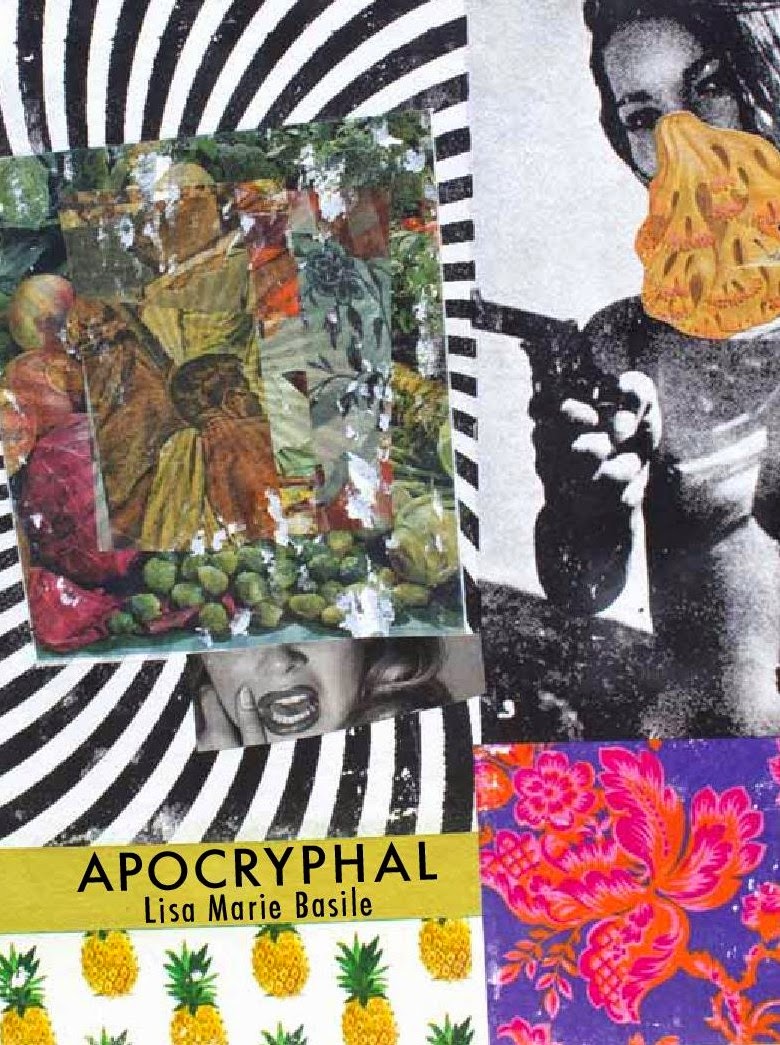
The Intoxicating Risks of a Poet’s Painful Blossoming: A Review of Lisa Marie Basile’s Apocryphal by Mindy Kronenberg

cover credit: Noctuary Press

Apocryphal by Lisa Marie Basile
Noctuary Press (2014)

Reviewed by Mindy Kronenberg

There is a solid, if not sometimes discomfiting, legacy of women poets taking ownership of victimization, familial or societal, within the larger sexual, emotional, and political playing fields of their generation. Sylvia Plath gave us the overbearing “Daddy,” Ann Sexton celebrated her body and moments of sensual reverie taken for madness, and Sharon Olds shared portraits of her family’s damaged and damaging patriarchs. How can we not admire Marie Howe’s “Mary Magdalene,” in a clever twist of self-declaration in citing the seven sins cast out of her (including: “The fourth was I didn’t belong to anyone. I wouldn’t allow myself to belong / to anyone. // Historians would assume my sin was sexual.”) or, in another poem, Magdalene’s ticking off the physical peculiarities and personalities of each male phallus she encounters.

In Apocryphal, the ambitious first full-length collection by Lisa Marie Basile, the poet creates a noirish tale against a surreal landscape that mingles (or perhaps blurs) memory and nostalgic illusion—a stylized series of personal and disturbing episodes. Before the larger narrative begins, an isolated section that serves as a preface provides clues to an evolving, pained history that precursors the narrator’s own flowering and debasement (“as a child his mother took an iron to him good, strangled / him in curtain cords.    so I’m your mother now // give it to me good.”). She states: “I am not like everyone else’s child, I learned early of toil & kink: little girl    bambi girl    sprawl for me / and I learned early all the men who want bambi…” But whether this transformation actually took place can be interpreted, like the title of the collection, as apocryphal in nature. She adds: “it might be the truth,    or not.   that is up to you.”

It is an intriguing, if not unsettling, start to a tale that often flickers across the page in vintage iconography (the douse of cologne, cabinets filled with booze, hands posed with cigarettes, scarved coiffures and boat-like sedans) and fragmented sexual encounters. It begins, Dali-like, with a dream-state of images:

When I sleep nude on sands, I open
my mouth so a whole man could get in, so you
could get in,
& stretching, I realize there is nothing but blackcoral,
          wrapping this body of me,

parts parting,

taken with you or taken by you. I wear the both of us,

as golden hoops in my ears.   the skin
is stretching all over the place, my hands are the hives,
& I smell of high valley fire.
o, it is very young of me to spill myself like this, a pearl
necklace snapped off by drunken blackness
     so dizzied
by the rotary tone of you.

There is a continual metamorphosis of the body, whether of the narrator’s or other female and male figures. These references approach the rhythms of spiritual service, a perversion of communion that can startle with violence (“my body of bark, my body of body // the salt, the sound of          hollow. // this legion, this inner summer. //I awake to you   my prayer  forcing me / with fists.”). In two other sequences:

our fathers and mothers make us holy
             in their form.

the form is       my fingers            inside myself
& then in your mouth.

you put them there, you did it.

you drink me, a little hair, a little salt.
my body tastes like the afternoon & I’m bent
in the shape of a woman, but I am not a woman.

you decide what I am. (p 35)

the small white dress I wear when the pain comes,
     with the stains on it.          this is my body.
this is my body.         this is my body. the sick
and the summer.        the air of a thousand men

blown up inside.        I live inside crates shipped
across the sea.         I venom good things. (p 85)

Although Apocryphal’s poems wander across the pages in a continuous release, without separate titles or standard formatting, there is a subtle application of style to break up or contain the book’s epic energies. This helps to “ground” the reader, temperamentally, as we experience the emotional interiors and exteriors of a life being revisited, shared, and self-investigated. On pages 26, 43, and 49 the narratives are presented as if boxed, like progressive, confessional pit-stops with the cinematic aplomb of capturing close-up monologues. In the first, we are told: “I keep growing & getting bigger, & my hair is soilblack now, … when you put your hands on my waist you say baby is this you?” and a remembered (or fantasized) night of shimmering light leads to an inflated sexuality but diminishing self and death of identity. In the second, we learn “I am afraid of photographs. I am ashamed they will show / where I really came from …” and again, intimacy is a force to be reckoned with from outside and within. The third is printed as two “boxes” separated by two lines that take us from “backstage” to the moment of her delivery to an on-screen persona, and that embodies the pageantry of rite (spiritual as well as theatrical). The narrator shares:

…                I have spent my entire life & all of its suffering
both as spectator and subject. a woman trapped eternally as a
child waiting for the holy father.

when he approaches I am cinema, a conquering, validation,
revolver and good mascara. he says,  you are beautiful.

With its edgy cinematic qualities, cast of familial and possibly invented characters, and shadowy events, Apocryphal effectively integrates noirish imagery and lyricism (“this woman is / a despicable thing / on our glossy sofa… those lashes / that bouffant:    a cage // an apron / an earring / a man / & a briefcase, // dead face down,    olive oil thighs …”). Told through a Fellini-esque lens, this is a woman’s odyssey of desire, shame, assertion, and redemption through telling her story with her own words, the truth present even in distortion. After all, whoever promised that grief, rage, or the excruciating process of healing and survival could ever truly be decipherable?